
AEO Glossary: Answer Engine and AI Search Terms
Short, plain definitions of the answer engine optimization and AI search terms US businesses run into: AI Overviews, citations, entities, llms.txt and every major AI crawler. Each term links to the page that explains it in depth.
- AEO, GEO, AI Overviews, AI Mode and AI crawlers by name
- Citations, entities, schema and llms.txt in plain words
- Each term links to the page that covers it in depth
AEO audit
An AEO audit checks whether AI crawlers can reach your site, whether your pages give quotable answers, and which buyer questions name you or your competitors in AI answers. It ends with a ranked fix list.
See the AEO auditAI crawler
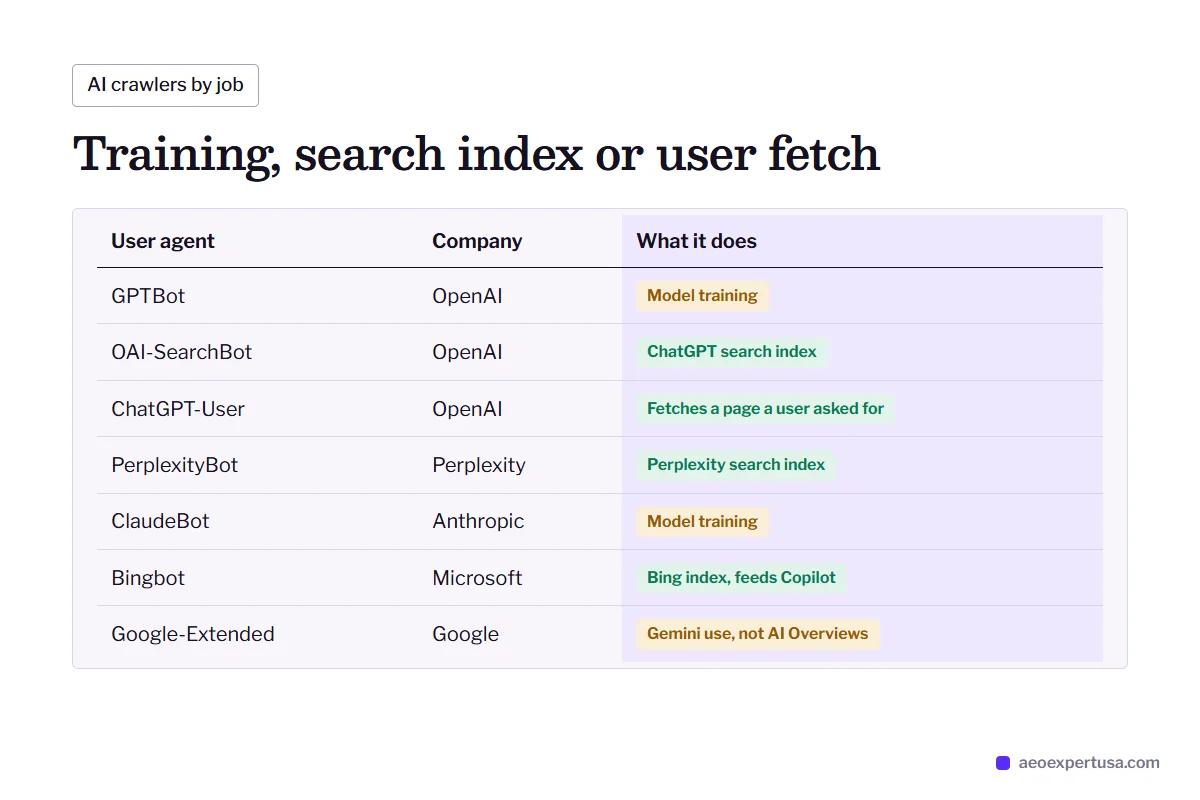
An AI crawler is a bot that fetches web pages for an AI company, either to train models, to build a search index, or to fetch a page a user asked about. Blocking the wrong one in robots.txt or a firewall can remove you from AI answers.
Fix blocked AI crawlersAI referral traffic
AI referral traffic is visits that arrive from links in AI assistants, such as chatgpt.com, perplexity.ai, gemini.google.com and copilot.microsoft.com. In GA4 these usually show as referral sessions. Clicks from Google AI Overviews and AI Mode count as Google organic traffic instead.
AI visibility trackingAI SEO
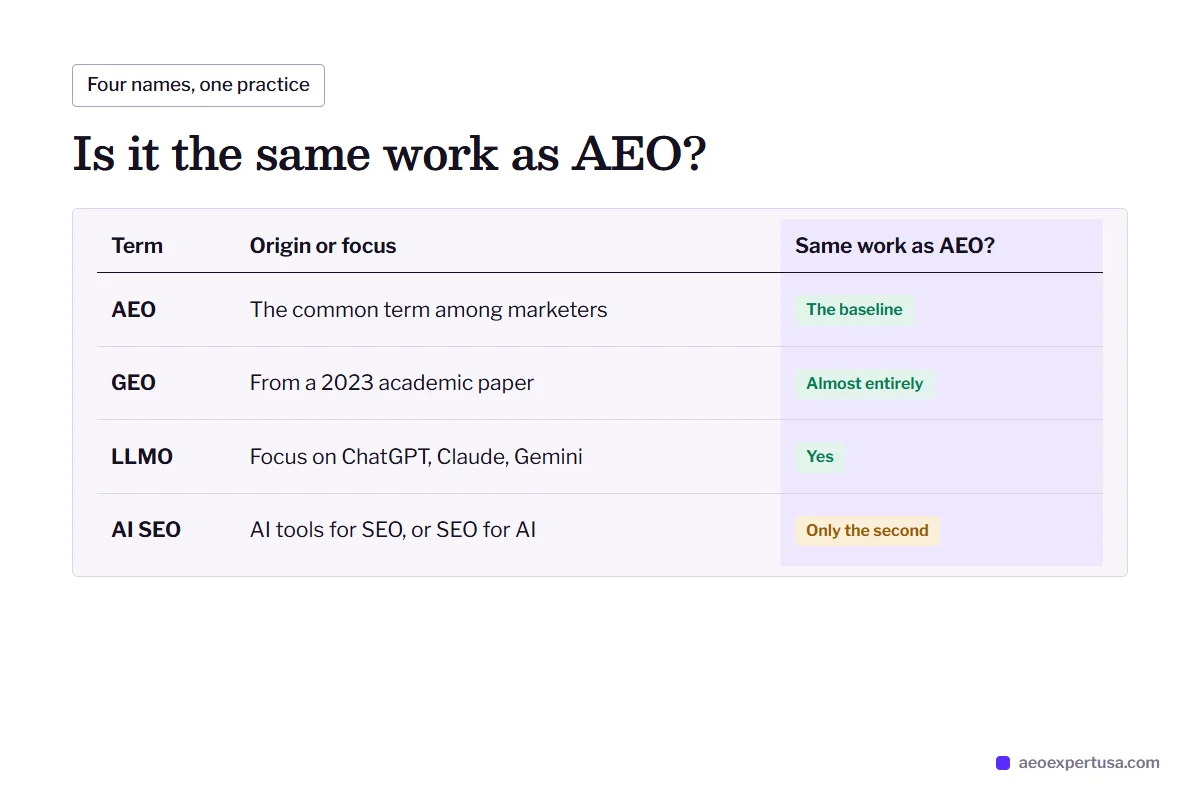
AI SEO is used for two different things: using AI tools to do SEO work, and optimizing a site for AI search. On this site it means the second, which is the same work as AEO.
AI SEO agency alternativeAI visibility
AI visibility is how often, and how prominently, a brand appears in AI answers for the questions its buyers ask. It is usually measured as the share of a fixed question set where the brand is named or cited.
Check your AI visibilityAnswer engine optimization (AEO)
Answer engine optimization is the practice of making a website easy for AI answer engines, such as ChatGPT, Google AI Overviews and Perplexity, to crawl, understand and quote. It covers crawler access, answer-first content, entity signals and tracking citations.
AEO servicesAnswer-first content
Answer-first content puts the direct answer to a question in the first one or two sentences, then adds detail, steps and sources. It is the format AI engines find easiest to lift and quote.
AEO content optimizationBingbot
Bingbot is Microsoft's crawler for the Bing search index. Bing's index also feeds Microsoft Copilot answers, so Bingbot access and Bing Webmaster Tools matter for AI visibility too.
Brand mention
A brand mention is your business named on another website or inside an AI answer, with or without a link. Consistent mentions on trusted sites help AI systems recognize and recommend a brand.
Digital PR for AEOCanonical URL
A canonical URL is the version of a page you want indexed when several URLs show the same or very similar content. You declare it with a rel="canonical" link, and Google treats it as a strong hint, not a rule.
ChatGPT-User
ChatGPT-User is the user agent OpenAI uses when ChatGPT visits a page because a user asked it to, for example to read a link. It is not used for automatic crawling of the web.
Citation
A citation is a link or source reference shown inside an AI answer, pointing to the page the information came from. Citations are the main way AI answers send visits to websites.
Track citationsClaudeBot
ClaudeBot is Anthropic's web crawler for collecting public content that may be used to train its Claude models. Anthropic documents its crawlers and how to control them in robots.txt.
Click-through rate (CTR)
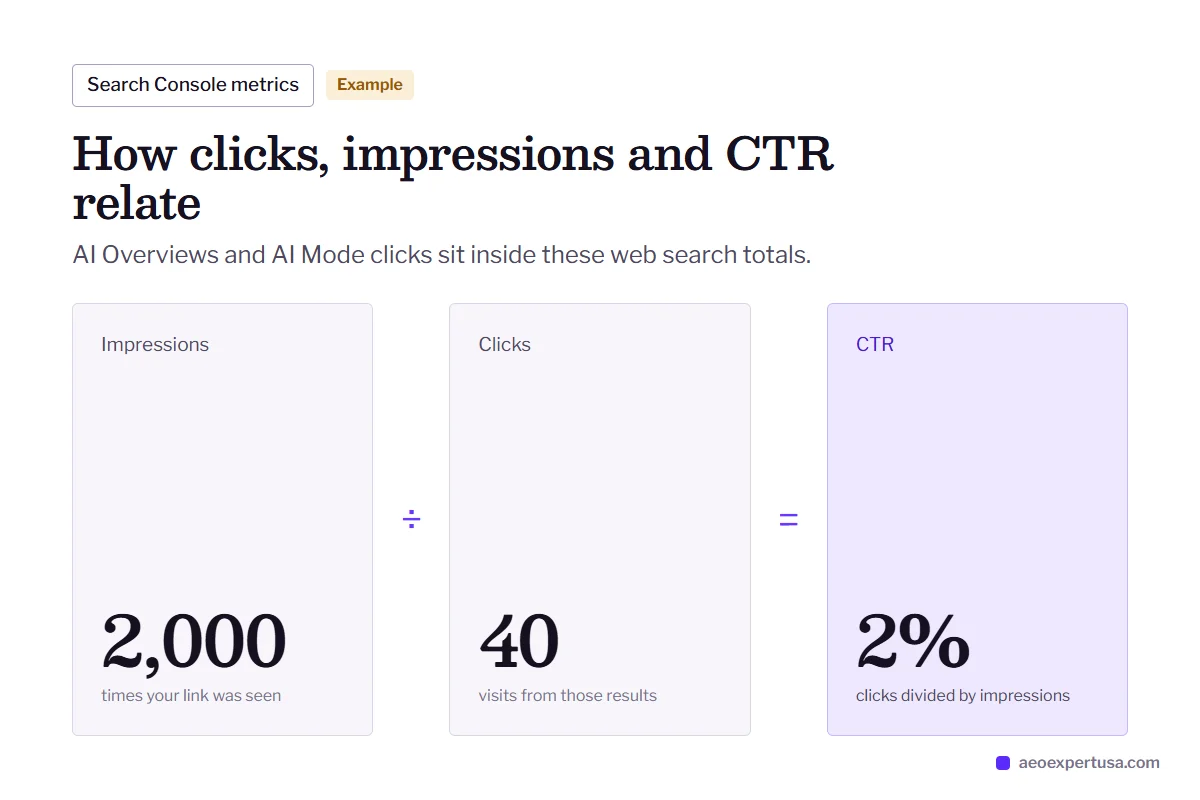
CTR is clicks divided by impressions, shown as a percentage. A low CTR at a good position usually points to a weak title or a result type that answers the question on the page.
Clicks
Clicks counts how many times a user clicked through from a Google search result to your site. Clicks from AI Overviews and AI Mode links are included in web search totals.
Entity
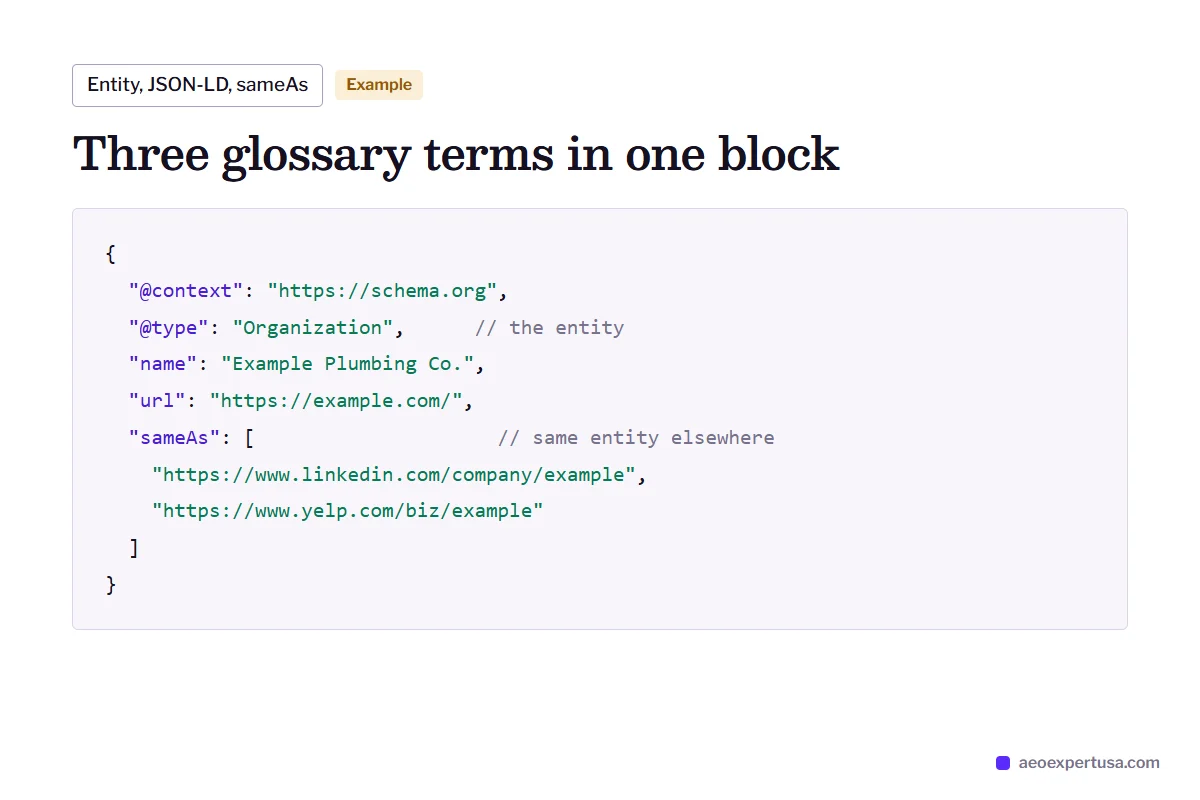
An entity is a distinct, identifiable thing, such as a business, person, product or place, that search engines and AI models can recognize. Google stores entities and their facts in its Knowledge Graph, so consistent facts about your business across the web make it easier to identify.
Technical AEOGenerative engine optimization (GEO)
Generative engine optimization means improving how often and how well a brand appears in answers written by generative AI systems. The term comes from a 2023 academic paper and overlaps almost entirely with AEO in practice.
GEO servicesGoogle AI Mode
AI Mode is a Google Search experience that answers in a conversational, AI-written format and supports follow-up questions. Like AI Overviews, it relies on Google's normal crawling and index, and its traffic is reported in Search Console under web search.
AI Overviews and AI ModeGoogle AI Overviews
AI Overviews are AI-generated summaries that appear at the top of some Google search results, with links to the pages they draw from. Google includes their traffic in Search Console's Performance report as part of web search; there is no separate AI Overviews filter.
AI Overviews optimizationGoogle Search Console
Google Search Console is Google's free tool for site owners. It shows how Google crawls and indexes your pages, which queries bring impressions and clicks, and any problems that affect how your site appears in Search.
Google-Extended
Google-Extended is a robots.txt token, not a separate crawler, that controls whether content Google crawls may be used to train Gemini models and ground answers in Gemini apps. It does not remove a site from Google AI Overviews or AI Mode, which use normal Googlebot crawling and the Google index.
AI Overviews optimizationGooglebot
Googlebot is Google's main web crawler. The pages it crawls and Google indexes are the pool that Google Search, AI Overviews and AI Mode draw from.
GPTBot
GPTBot is OpenAI's crawler for collecting content that may be used to train its models. Blocking GPTBot does not by itself remove a site from ChatGPT search results, which use OAI-SearchBot.
AI crawler settingsGrounding
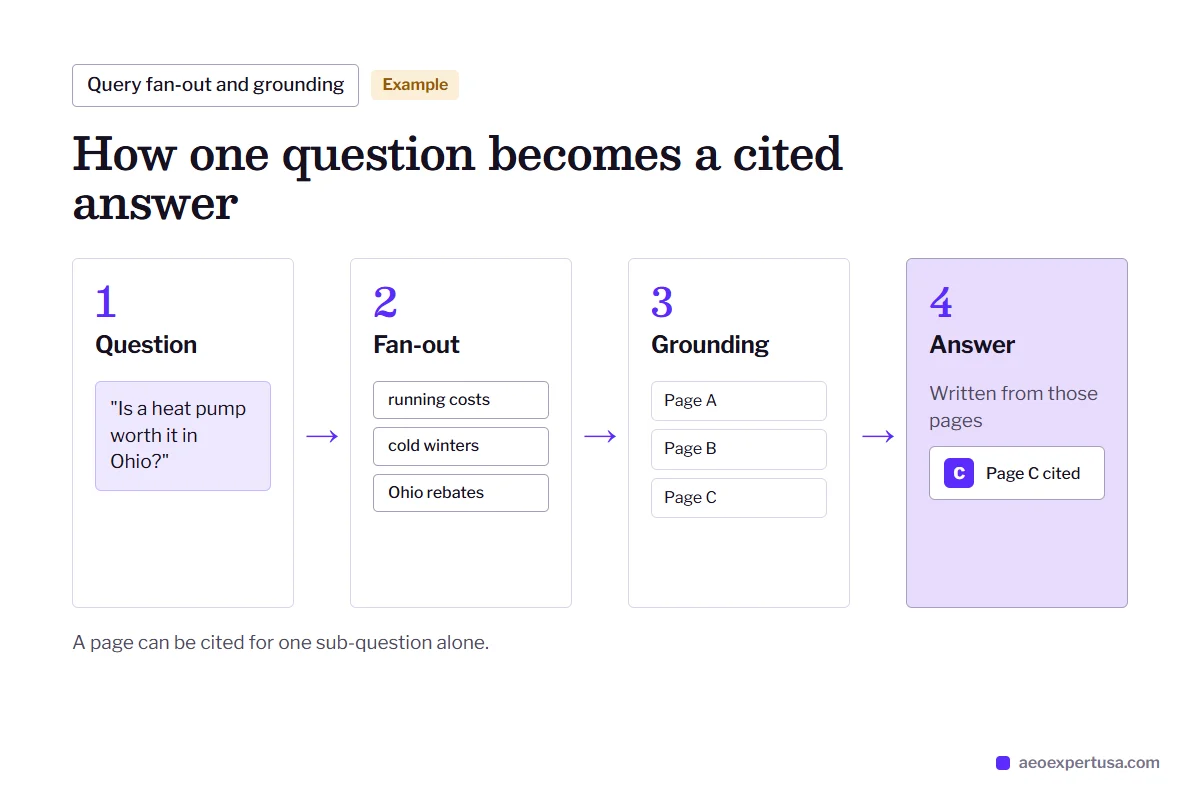
Grounding ties an AI answer to sources retrieved at the time of the question, such as search results, instead of relying only on what the model learned in training. This retrieval step, often called retrieval-augmented generation (RAG), is where pages get the chance to be cited.
Impressions
Impressions counts how many times a link to your site appeared in search results a user saw. A sudden drop in impressions is often the first sign of an indexing or ranking problem.
JSON-LD
JSON-LD is the format Google recommends for adding structured data. It sits in a script block on the page, separate from the visible content, which makes it easy to add and maintain.
Schema and entity workLarge language model (LLM)
A large language model is an AI model trained on very large amounts of text to understand and generate language. LLMs power ChatGPT, Gemini, Claude and the answers in Google AI Overviews.
LLM optimization (LLMO)
LLM optimization is another name for AEO that focuses on large language model products such as ChatGPT, Claude and Gemini. The goal is the same: be found, understood and cited when those models search the web.
ChatGPT and LLM optimizationllms.txt
llms.txt is a proposed standard, described at llmstxt.org, for a Markdown file at your site root that lists your key pages for large language models. No major AI engine has confirmed it as a ranking or citation signal, so treat it as low-cost and optional.
Generate an llms.txt fileOAI-SearchBot
OAI-SearchBot is the OpenAI crawler that finds and indexes pages so they can appear and be cited in ChatGPT search results. If you want ChatGPT to cite your site, it needs access.
ChatGPT optimizationPerformance report
The Performance report shows how your site does in Google Search: clicks, impressions, CTR and average position, broken down by query, page, country, device, search appearance and date. Data is kept for 16 months.
PerplexityBot
PerplexityBot is Perplexity's crawler for finding and indexing pages that can be shown and linked in Perplexity answers. Blocking it reduces your chances of being cited there.
Query fan-out
Query fan-out is the technique Google describes for AI Mode: one question is split into several related sub-queries that are searched at the same time. Pages can be cited because they answer one of those sub-questions well, not only the original query.
robots.txt
robots.txt is a text file at the root of your site that tells crawlers which paths they may crawl. Rules are set per user agent, so you can allow or block individual AI crawlers such as GPTBot or PerplexityBot.
Test your robots.txtsameAs
sameAs is a schema.org property that links your Organization or Person markup to your official profiles elsewhere, such as LinkedIn or Wikipedia. It helps machines confirm that those profiles describe the same entity.
Structured data
Structured data is code that describes a page's content in a standard vocabulary, usually schema.org. It helps search engines understand the page and can make it eligible for rich results in Google.
Fix structured data errorsURL Inspection tool
The URL Inspection tool shows Google's indexed information for one URL, including whether it is on Google, when it was last crawled and which canonical Google selected. A live test checks the current version, and Request indexing asks Google to recrawl it, within a daily quota.
XML sitemap
An XML sitemap is a file that lists the URLs you want search engines to find, optionally with last-modified dates. It helps discovery but does not make Google index a page.
AEO Glossary FAQs
Does Google Search Console show AI Overviews data?
Partly. Google says AI Overviews and AI Mode traffic is included in the Performance report as part of web search. There is no separate filter for it, so tracking AI visibility needs a mix of Search Console data and live AI answer tests.
What is the difference between AEO and GEO?
In practice, very little. AEO (answer engine optimization) and GEO (generative engine optimization) both mean making your site easy for AI systems to crawl, understand and cite. GEO is the term from academic research; AEO is more common among marketers.
Is llms.txt required for AI search?
No. llms.txt is a proposed standard that no major AI engine has confirmed as a ranking or citation signal. It is cheap to add, so some sites publish one, but crawler access and good content matter far more.





Put the terms to work
Make AI recommend your business, starting this week
Hire an AEO expert who works from your data, not guesses.